


Launch offer

Traditional astrology, nothing modern invented

The tradition divided the body into regions. Your chart says who governs each one.

From head to feet, every region has a ruler, a temperament and a regimen. The Health Map calculates yours across five factors and returns the chapters the sources support — never a list of twelve signs that is the same for everyone.

See what is written inside
  • Sources cited by name
  • 7-day guarantee
  • In your inbox in minutes
  • Pay by credit card

More than 2,800 charts generated

Traditional astrology · One-off payment · 7-day guarantee

See inside

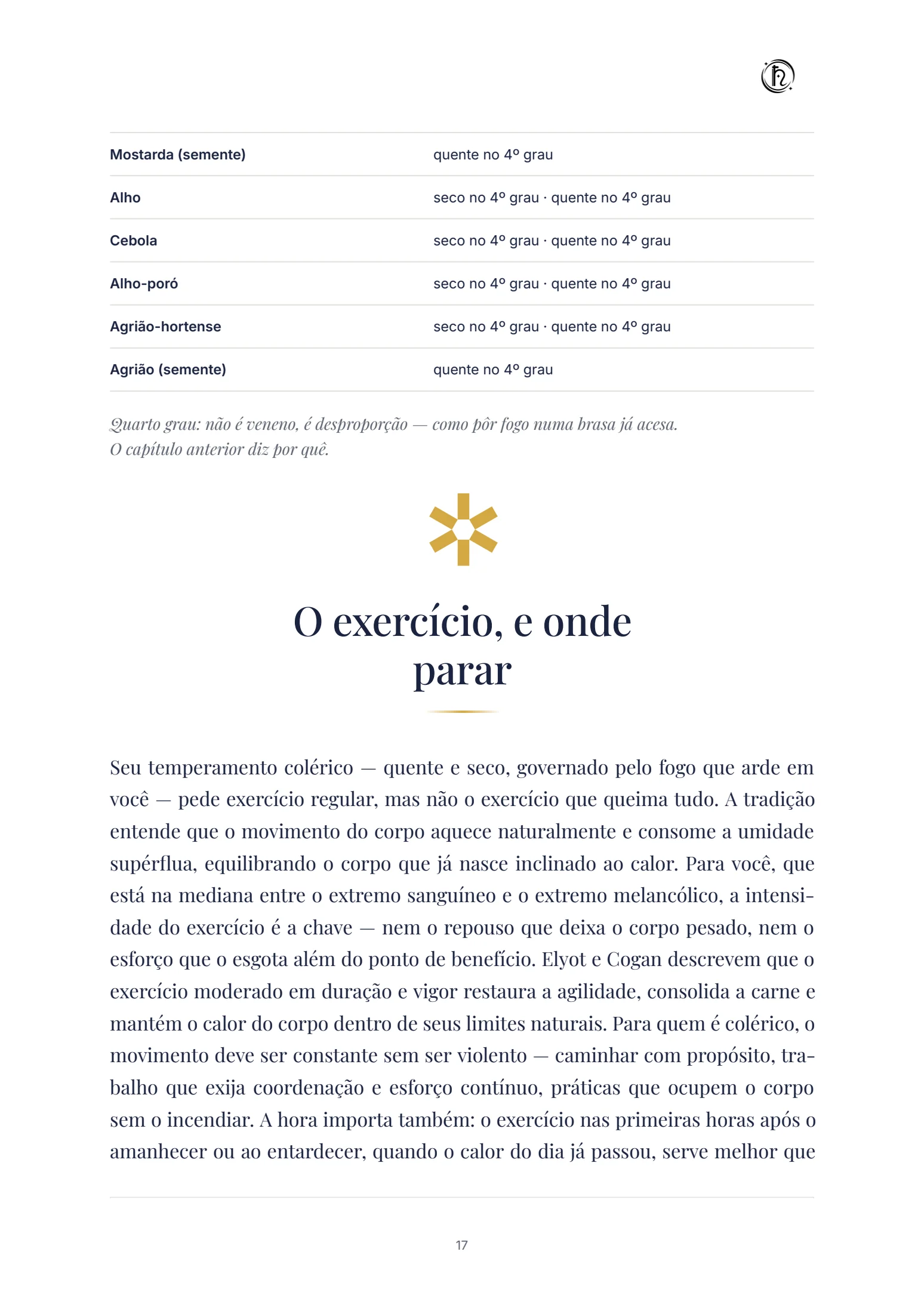
A real page from the report, exactly as it is delivered

Not an illustration and not a mockup: it is the page printed in your report, with the twelve regions named. In yours, the regions your chart accentuates come out in gold and the rest in light outline — because the page also says what your chart does not accentuate.

The melothesic man: a body with the twelve sign emblems drawn over the regions each one governs, from the ram at the forehead to the fishes at the feet
  • Aries
    Head and face
  • Taurus
    Neck and throat
  • Gemini
    Arms and shoulders
  • Cancer
    Chest and stomach
  • Leo
    Heart and back
  • Virgo
    Belly and bowels
  • Libra
    Kidneys and lower back
  • Scorpio
    Genitals and bladder
  • Sagittarius
    Thighs and hips
  • Capricorn
    Knees
  • Aquarius
    Legs and shins
  • Pisces
    Feet

In gold, the regions the chart accentuates. The others are governed too — every sign has a ruler — but no significator points to them.

See inside

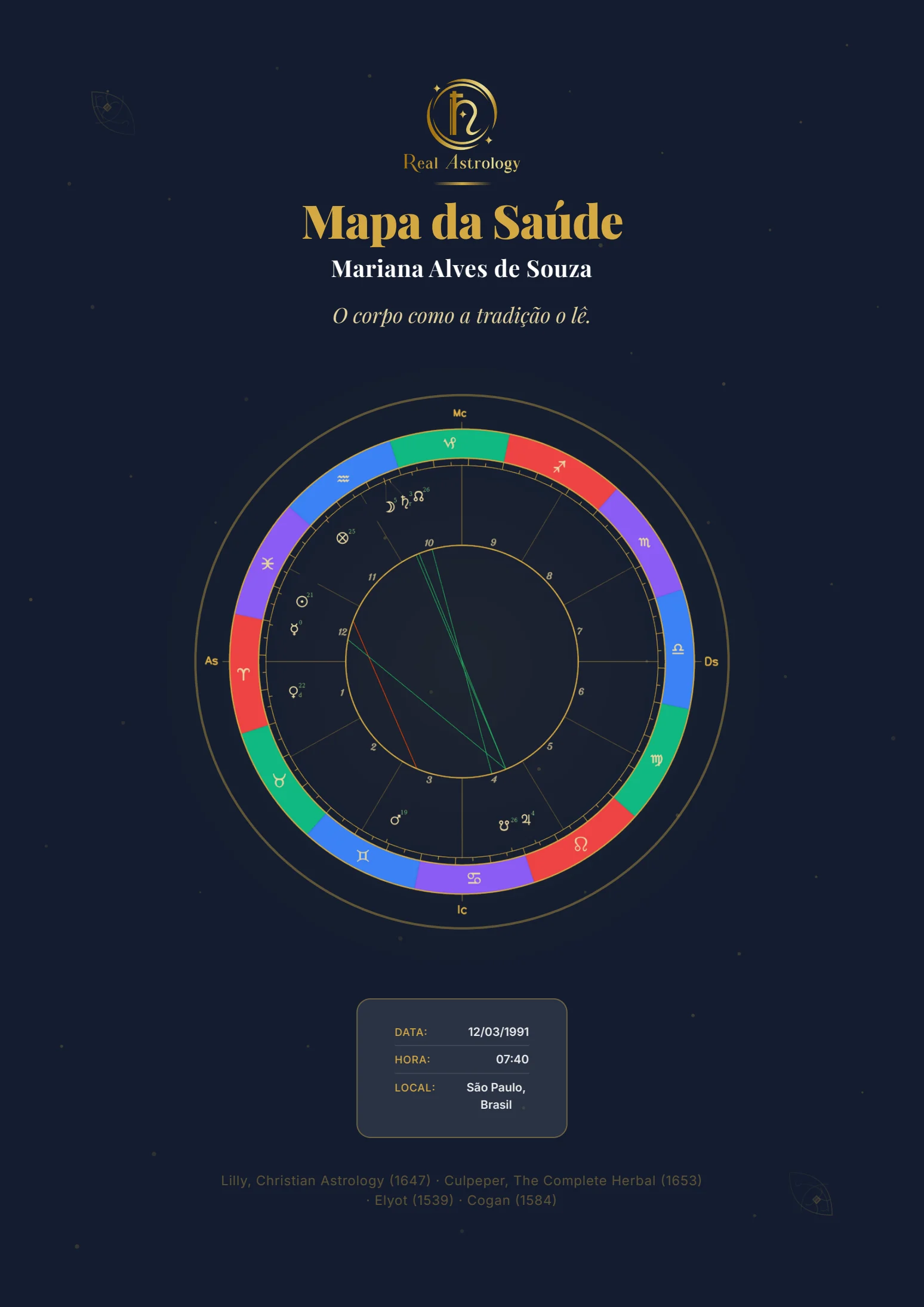
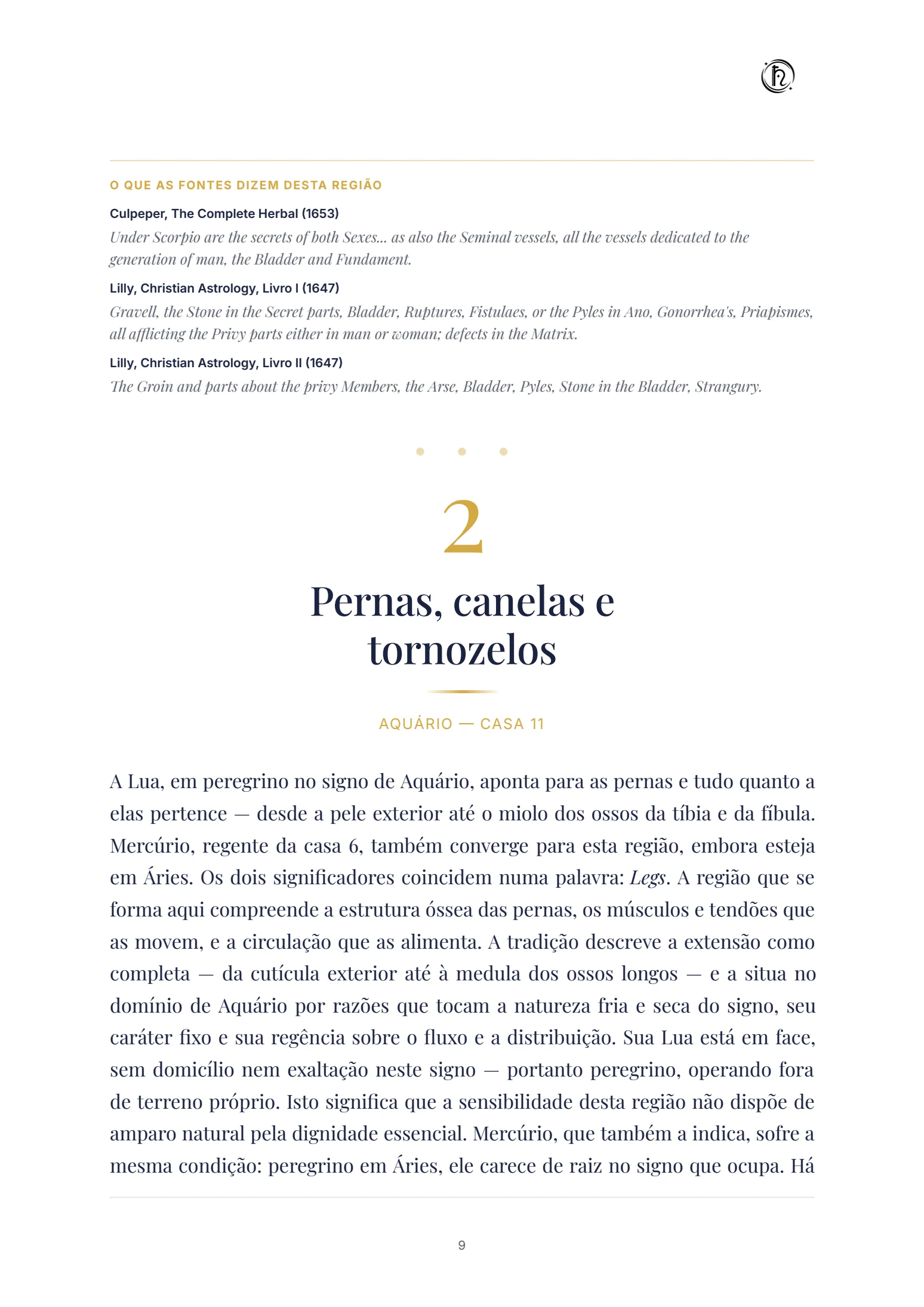
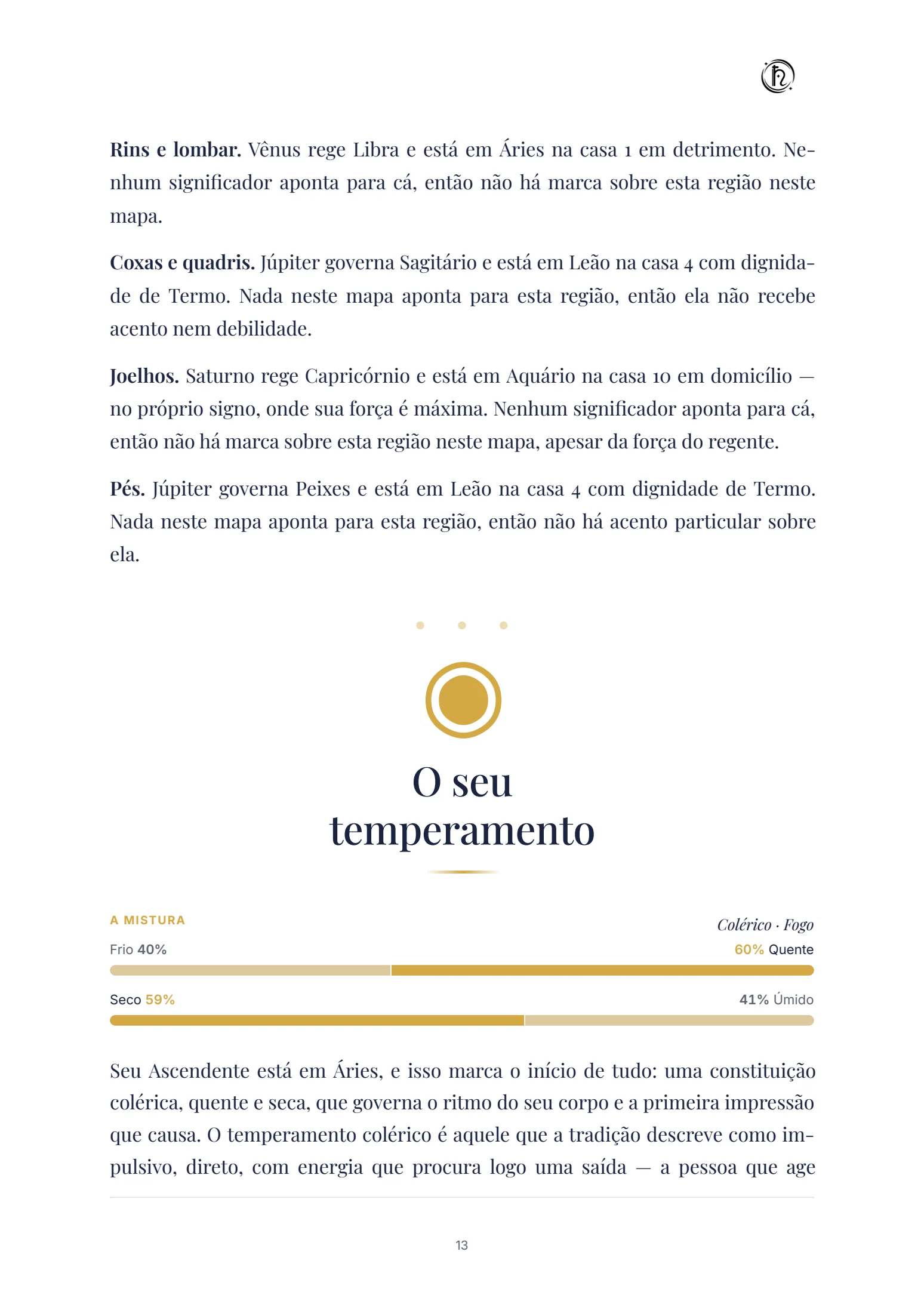
Real pages, from an example chart

We generated the report for an illustrative birth date. The pages are the real output of the product — it is the chart that belongs to no one.

No image is a mockup. Every page is the real output of the product.

What you will know

Six questions your chart answers — and no horoscope reaches

  1. Which region of the body your chart accentuates, and by which significator
  2. Which of the four temperaments predominates, calculated across five factors
  3. What Lilly wrote about your exact planet-in-sign combination
  4. What each of the five sources wrote about your region, verbatim
  5. Which regimen the tradition prescribed for your temperament
  6. Which chapters your chart does not generate, and why

The report does not invent a chapter to fill a page.

What is inside

What always arrives, and what depends on your chart

Always

  • Your significators and what each one rules
  • Temperament across five factors, with each axis measured against the median
  • The melothesic man with your regions
  • Regimen: diet, foods and exercise, by degree
  • The silent regions — what your chart does not accentuate
  • Appendix of the twelve parts, as the five sources give them

What only your chart decides

From 1 to 5 region chapters — and which ones you get is not our choice. Four significators of your birth vote; where two or more point at the same region, the chapter is born. That is why no two reports share an index.

The average is 1.62 chapters. A dispersed chart does not make a worse report — it makes a different finding, and that finding is written down.

The method

Two layers, and they are different

One says where to look. The other says what to do. They are independent — and when one falls silent, that silence is a result too.

Where your body gathers

Four voices in your chart point to regions through Lilly's table: the lord of the Ascendant, the Moon, the lord of the sixth house and the sign on the sixth itself — a clause almost nobody uses. Where two or more agree there is concentration; Lilly writes that there the judgement becomes "more certain, and I dare say infallible". Where they do not agree, the report says so, because dispersion is a finding and not a gap.

What the tradition would do with a temperament like yours

Your temperament comes out of five factors, and the margin of each axis is compared against the median of a measured population. The excess belongs to the axis, never to the temperament: nobody is "excessively phlegmatic" — someone is pronounced in cold, or in moist, and the two travel apart. An axis at the median is maintained by the like; a pronounced axis is corrected by the contrary, matching in degree.

Where each sentence comes from

The attribution is the product

No sentence in the report comes from "the tradition says". Every citation is verbatim, with author, work and year — in the spelling of 1647.

  • William Lilly, Christian Astrology (London, 1647)

    The planet-in-sign → member of the body table, transcribed by hand from two facsimiles. It is two pages, not one: almost everyone who cites it uses half.

  • Nicholas Culpeper, The Complete Herbal (1653)

    The only author with planet, quality and DEGREE in the same entry. The regimen comes from him — and he is also the one who rejects Lilly's table by name, with a clinical counterexample.

  • Thomas Elyot (1539) and Thomas Cogan (1584)

    The rule of the like and the contrary, and the stopping rule for exercise. The tradition speaks of intensity, duration, hour and season — never of modality.

The sources disagree with each other, and that changes what you read

Firmicus Maternus, in the fourth century, gives the heart to Cancer — the reverse of what sounds obvious today. Manilius gives flanks and shoulder blades to Leo and gives the heart to no sign at all. "Leo governs the heart" is Lilly and Culpeper, not "the tradition". Four of the twelve lines diverge, and that is why the report names every source instead of saying "the tradition says".

Annex

The twelve parts, as the sources have them

This table is the same for every reader, and the page says so: it is the method, not the reading. What changes from person to person is what the calculation does with it.

The length varies, and that is deliberate

A chart with three converging regions yields more pages than a dispersed one — and the dispersed one is not a worse report, it is a different finding. We would rather have a report that follows your chart than a fixed page count that forces padding.

How it works

  1. You fill in your data

    Name, date, time and place of birth — exactly as for any birth chart.

  2. The engine calculates, and only then does anyone write

    Convergence, table cells, dignities, sect, reception, axis margins and the degree of every food come out of the calculation. The prose never picks an author and never invents a degree.

  3. You get your written map

    Within minutes the report reaches your inbox, in digital form to read on your phone or computer, with the appendix of the twelve parts and the verbatim citations from every source.

Before you decide

The honest questions about the Health Map

What exactly am I buying?

A symbolic document about a sixteenth- and seventeenth-century tradition: what Lilly, Culpeper, Elyot and Cogan wrote, applied to your natal chart. It is not professional guidance, it replaces none, and it promises no outcome of any kind. The report repeats this on its own back cover.

Isn't astrology about health irresponsible?

It would be, if it made things up. Here every sentence carries an author, a work and a year — you read what Lilly wrote in 1647, not what we think in 2026.

What if my chart accentuates nothing?

It happens to roughly one chart in eight, and the report says so in plain words. Dispersion is a finding, not a failure — and you still receive temperament, regimen and appendices.

Is it worth $9.90?

It is three books run against your chart, with page and year in every sentence. A facsimile of Christian Astrology alone costs more than this — and it does not come calculated for your birth.

What if I don't like it?

Seven days, no questions. It is digital: you will have read all of it by the time you ask — and we still refund you.

What it costs to get here on your own

The road to this reading, with and without the shortcut

Christian Astrology, facsimile
$80+
Reading pages 119 to 121 in 1647 English
a weekend
The Complete Herbal, by Culpeper
$35+
Running both against your chart
knowing how to calculate
Finding where the authors disagree
a line-by-line comparison
Real Astrology · all of it already run against your chart, yours forever
$9.90

$9.90, once. It is not a summary of what those books say — it is what they say about your chart, with page and year.

Launch offer

Health Map price

$19.00$9.90
  • Temperament across five factors, with the margin of each axis
  • From 1 to 5 region chapters, according to your chart
  • Regimen by degree: diet, food table and exercise
  • Annex of the twelve parts, with the verbatim citation of every source
  • In your inbox in minutes
  • 7-day guarantee. If it does not make sense, we refund you.

One-off payment. No subscription and no renewal.

7-day guarantee. If the report does not make sense to you, we refund you.

Frequently asked questions

To close

The report that admits when it has nothing to say

Four voices read your chart. Where two agree, a chapter is born. Where none agree, the page says so — instead of padding it out with sign clichés.

One-off payment · in your inbox in minutes