

The highest of the seven
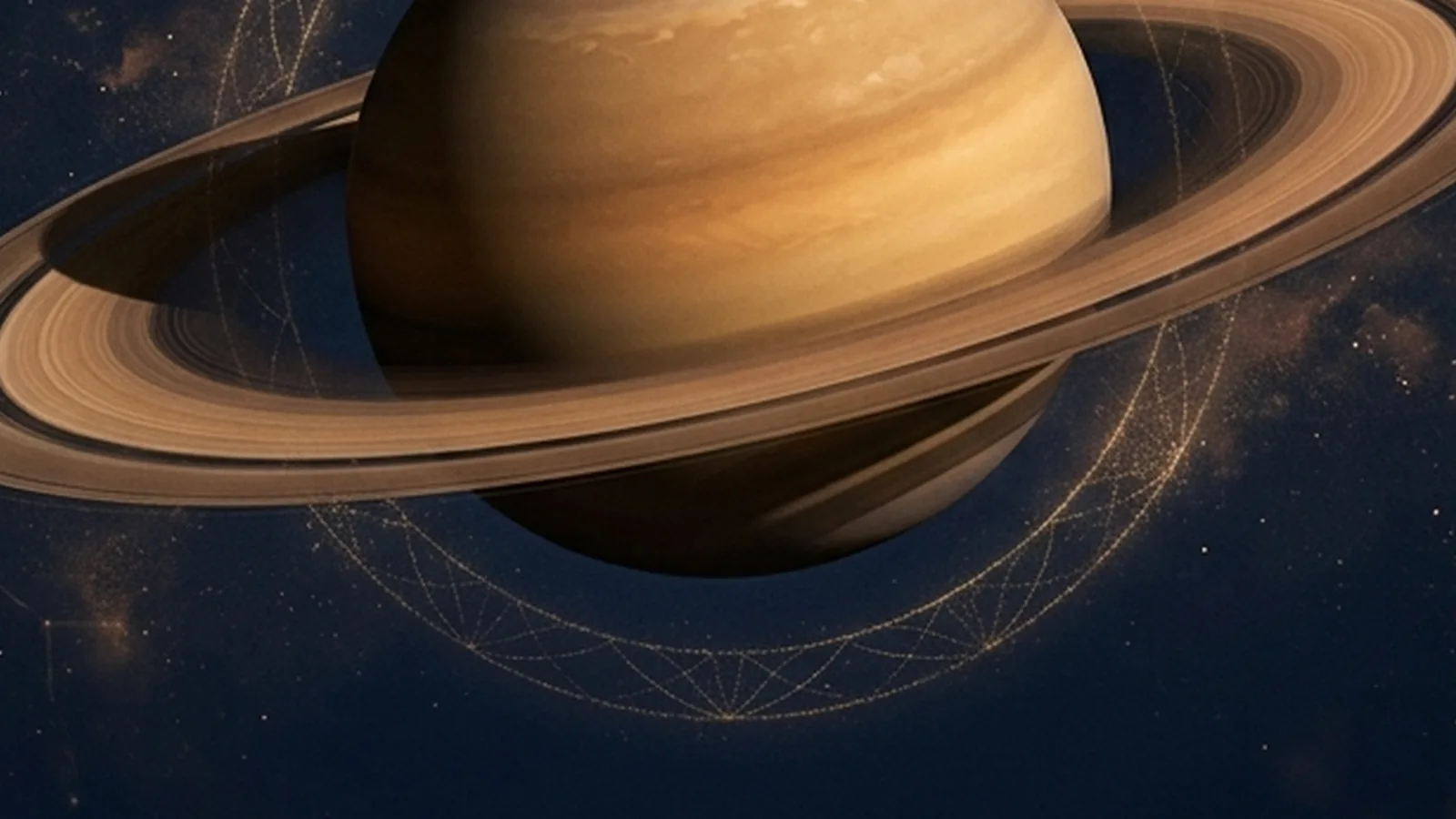
aturn is the most distant planet visible to the naked eye, and for this reason the ancients placed it in the outermost sphere, marking the boundary between the world of movement and the motionless world of the fixed stars. Its slow march through the zodiac — about 29 and a half years to complete one revolution — made it, from the earliest times, the lord of time, of limit, and of old age. Where the other planets race, Saturn lingers; and what lingers, in the language of the astrologers, is what demands patience.
Its glow is pale and yellowish, without the radiance of Jupiter or the blood of Mars. This cold and remote light gave Saturn its own temperament: cold and dry, the melancholic humour, that of the earth which does not move.
Astronomical data
| Characteristic | Value |
|---|---|
| Average distance from the Sun | 9.5 AU (1.4 billion km) |
| Orbital period | 29.5 Earth years |
| Rotation period | 10.7 hours |
| Diameter | 116,460 km (9× Earth) |
| Average temperature | -178°C |
Observational curiosity: Saturn is the last planet visible without instruments. Galileo, on pointing his telescope, saw its rings and took them for "ears" — the ancients never knew them, but already sensed that this body was the gravest and most distant of the seven.
The mythology: Cronus and Saturn
Cronus was the youngest of the Titans, son of Uranus (the Sky) and Gaia (the Earth). Uranus hated his children and kept them imprisoned in Gaia's womb. She, in agony, forged a sickle of adamant and begged for help; only Cronus had the courage to act. With the sickle, he castrated his father. From the blood of Uranus were born the Erinyes and the Giants; from the foam of the organs cast into the sea, Aphrodite was born.
Cronus then ruled the cosmos during the Golden Age, an era of peace and abundance. But a prophecy said he would be dethroned by a son, as he had dethroned his father. To prevent it, he devoured each child Rhea gave him. Rhea hid the last one, Zeus, in Crete, and handed Cronus a stone wrapped in cloth. Zeus grew up, freed his siblings, and won the Titanomachy.
The myth holds the whole astrological doctrine: Saturn is the time that devours, the severe father, the limit that separates the ages. He is not a god cruel by whim — he is the law of what ends.
Nature and sect
Saturn is the greater malefic of the tradition: the body that, by nature, restricts, chills, delays, and deprives. But the doctrine of sect tempers this judgment. Saturn is a diurnal planet — it belongs to the hairesis of the Sun. In a birth by day, with the Sun above the horizon, Saturn is in its sect and behaves in the mildest way possible to it: it still cuts, but with method, giving structure and duration to what it touches. In a nocturnal birth, out of sect, its coldness weighs more heavily and the deprivation hurts more.
The ancients did not say that a malefic in sect became benefic — they said it "behaved." Diurnal Saturn is the severe but just elder; nocturnal Saturn is the bitter old man. The same cold and dry nature, two faces, according to whether the light of day accompanies it or not.
Essential dignities
| Dignity | Sign(s) |
|---|---|
| Domicile | Capricorn and Aquarius |
| Exaltation | Libra |
| Detriment | Cancer and Leo |
| Fall | Aries |
In domicile, Saturn is in its own house: it acts with full authority, gives structure, perseverance, and the fruit that only time ripens. Capricorn and Aquarius are the signs of winter, cold like it. In its exaltation in Libra, it is received as a guest of honour — the planet of justice and measure gains the scales, and its severity becomes equity and right judgment.
In detriment, in Cancer and Leo (the domiciles of the luminaries, opposite to its own), Saturn is away from home: the cold and dry enters the signs of warmth and life, and all it does is by obstruction. In its fall, in Aries — the sign of martial impulse —, the slow old man is thrown where all is haste and fire: there he loses his bearings, and his significations turn against him.
The joy of Saturn
Each planet has a place (house) in which it "rejoices," that is, where it best exercises its nature. The joy of Saturn is the 12th house — the place of hidden enemies, of prisons, of exiles, of long illnesses and of withdrawal. It is not a joyful house in the common sense; it is the place where the saturnine nature is fulfilled with propriety: solitude, enclosure, hidden labour, renunciation. Saturn is at home there because the 12th house is the shadowy corner of the chart, far from the Ascendant, like the elder withdrawn from the world.
Traditional significations
Saturn signifies, above all, time, limit, old age, and death — the end of all things. From this the rest follows:
- Themes: privation and scarcity, discipline and duty, patience, melancholy, perseverance, what is old and enduring.
- People: the elderly, grandparents and the father (in part), landlords, monks and hermits, miners and farmhands.
- Trades: agriculture and the working of the land, mining, building that lasts, patient administration — everything that requires time and solidity.
- Body: the bones, the teeth, the skin, the spleen; the extreme ages and the ills of cold — rheumatism, deafness, melancholy.
- Age: old age, the last of the seven ages of man.
- Metal: lead, heavy, dark, and the most common of the dense metals.
How to judge Saturn in the chart
The traditional reading does not ask "Is Saturn good or bad?" but in what state it is found. Saturn dignified (in domicile or exaltation), in a good house, in sect, gives longevity, lasting authority, and the wisdom that comes from experience. Saturn debilitated (in detriment or fall), in a dark house, out of sect, and struck by an adverse ray, brings delays, privation, isolation, and bitterness. The difference always lies in the condition, not in the mere presence.
Saturn, well disposed, makes men profound in thought, serious, constant in their purposes, reserved and patient; ill disposed, it makes the avaricious, the sad, the solitary, and those who lose everything through delay.
CTA: See in which sign and house Saturn fell at your birth and how it is disposed in your chart — generate your natal chart.