

The star of beauty
enus is the brightest of the wandering bodies, so luminous that it can be seen in daylight under favourable conditions. The ancients saw it in two ways: as the Morning Star (Phosphorus) when it preceded the dawn, and as the Evening Star (Hesperus) when it followed the sunset — and for a long time they believed these were two bodies. This double brilliance, soft and constant, made it the significator of love, of beauty, and of all the delights of life. It is the lesser benefic, the author, in the words of the ancients, of joy, of music, and of pleasure.
Astronomical data
| Characteristic | Value |
|---|---|
| Average distance from the Sun | 0.72 AU (108 million km) |
| Course through the zodiac | ~225 days |
| Synodic period | 584 days |
| Diameter | 12,104 km (0.95× Earth) |
| Greatest distance from the Sun | ~47° |
Observational curiosity: like Mercury, Venus never strays far from the Sun — at most about 47°. For this reason it always appears at dawn or at dusk, never in the middle of the night. Its morning (oriental) or evening (occidental) appearance alters its condition, as we shall see.
The mythology: Aphrodite and Venus
Aphrodite was born in an extraordinary way: when Cronus castrated his father Uranus and cast him into the sea, from the foam (aphros) the goddess was formed, who emerged adult and perfect upon a shell, on the island of Cyprus. Married to Hephaestus, the lame blacksmith, her heart belonged to Ares — a union of pleasure with ardour that astrology recognizes in the affinity between Venus and Mars. She possessed a girdle that made irresistible whoever wore it; not even the gods escaped her charm.
The myth portrays well the astrological nature of Venus: the goddess who reconciles, sweetens, and unites — the principle of attraction, harmony, and delight in the world.
In traditional astrology
Nature and sect
Venus is the lesser benefic, of a cold and moist (phlegmatic) temperament, feminine, of the nocturnal sect. As a benefic, it prospers and softens all that it touches; as a body of the night, it behaves better in nocturnal charts, where it belongs to the sect in prominence. It moves at a speed close to that of the Sun.
Essential dignities
| Dignity | Sign(s) |
|---|---|
| Domicile | Taurus and Libra |
| Exaltation | Pisces (27°) |
| Detriment | Aries and Scorpio |
| Fall | Virgo |
Venus rules two signs: Taurus (nocturnal domicile, of earth — stable, sensory pleasure) and Libra (diurnal domicile, of air — harmony, bond, measure). It is exalted in Pisces, where love becomes compassion and sweetness. In detriment, in Aries and Scorpio (the domiciles of Mars), the sweet principle is forced by martial ardour; in fall, in Virgo, minute analysis dries up what Venus wants fluid and gentle.
Venus has its joy in the 5th house — the place of Good Fortune, of children, of pleasure, and of joy. There the lesser benefic recognizes itself, acting in the fullness of its festive and generous nature. A Venus in the 5th, well disposed, is one of the sweetest testimonies a chart can have.
What Venus signifies
By nature, Venus governs:
- Love, union, and marriage — the way of loving and of being loved;
- Beauty, art, and music — the sense of the beautiful and the harmonious;
- Women and the feminine ideal in the native's life;
- Pleasure, sweetness, and comfort — all that pleases the senses;
- Concord and diplomacy — the art of reconciling;
- in the body, the kidneys and what touches the harmony of the humours; among the metals, copper.
The condition of Venus in the chart
Like every planet, Venus is judged not by sign alone, but by its whole state. Dignified and well aspected, it gives charm, artistic talent, requited affection, and tranquil prosperity. Debilitated — peregrine, in detriment or fall, or wounded by a malefic — it inclines to vanity, to indolence, to excess in pleasure, and to disorder in the affections. The benefic never ceases to wish for good; but it realizes it fully only when its state allows.
Its relation to the Sun also matters: oriental (morning) or occidental (evening), and whether it is free of the beams or combust. Combust Venus has its sweet meaning overshadowed by the light of the king.
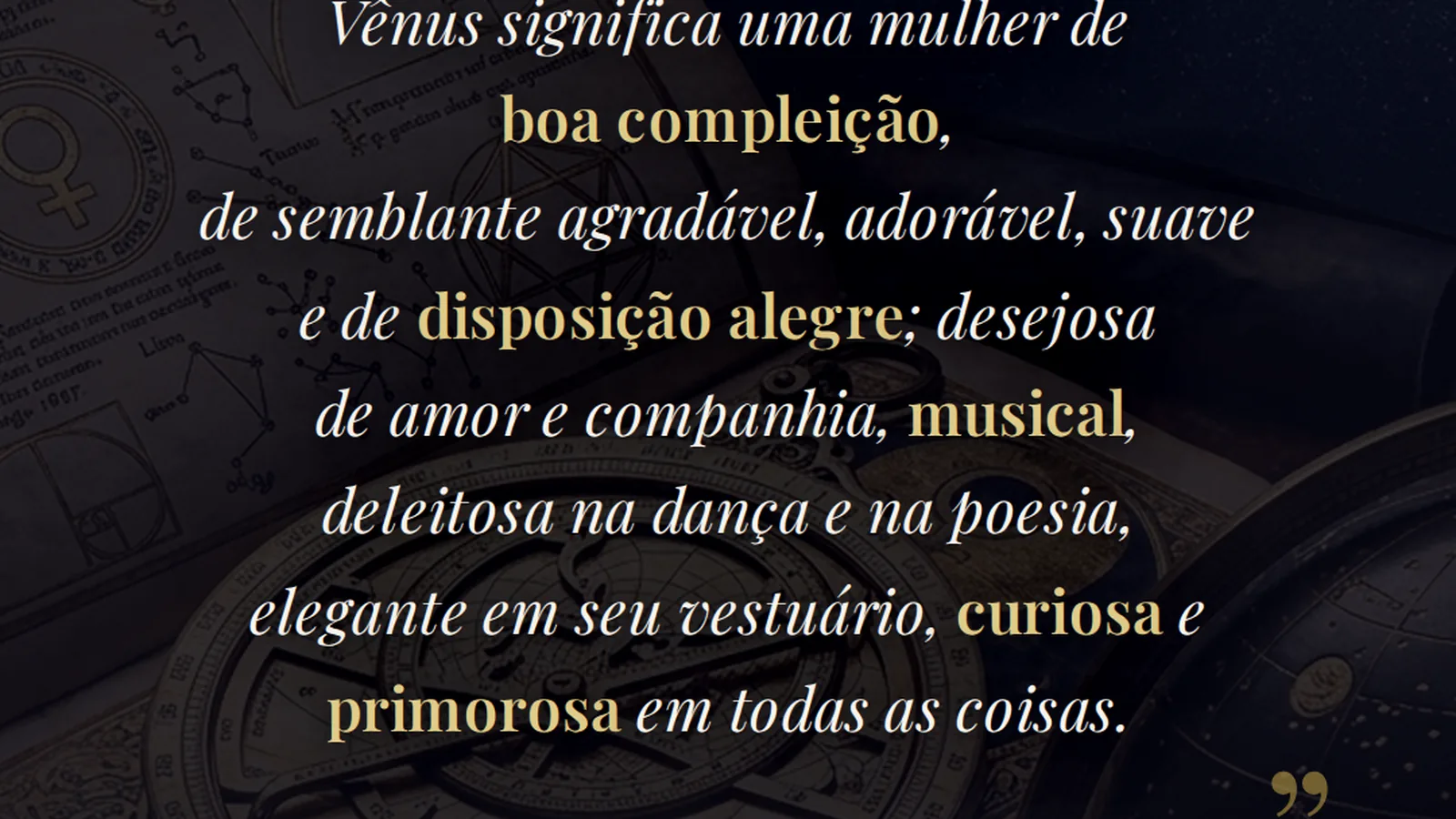
Venus is a feminine planet, temperate, nocturnal, the Lesser Benefic, author of joy, festivity, music, and love.
Ask, in this order: in which sign is it and what dignity does it have there? In which house, and what is its joy or affliction of place? What aspects does it receive from the benefics and malefics? Is it free of the Sun's beams or combust? Only the whole tells how the native loves and what gives them delight — the sign of Venus, alone, is only the beginning.
Conclusion
Venus is the sweetness of the heavens — the principle that unites, beautifies, and appeases. To read it in the traditional way is to weigh its dignity, its sect, its house, and its relation to the Sun, and not to reduce the love of a life to a mere "Venus sign." Well disposed, it is the gentlest of testimonies; afflicted, it asks for awareness so that the desire for pleasure does not turn against the native.
Want to see your Venus judged by sign, dignity, and house? Generate your natal chart and read the full interpretation.